Perfectly framed, two zebras in the dry African bush

Golden light, the arid African bush and two zebras on the way to the waterhole, perfectly framed in the short timeframe where the equator sun sits just above the horizon.
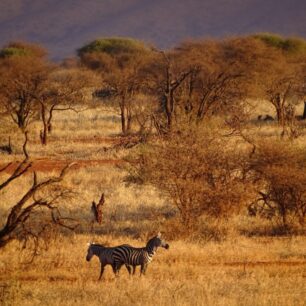
Golden light, the arid African bush and two zebras on the way to the waterhole, perfectly framed in the short timeframe where the equator sun sits just above the horizon.
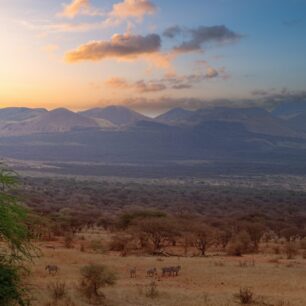
Up early, all is quiet. The sun rises slowly from the horizon, and the soft light begins to shape the landscape. Dark shadows give way to mountains, acacia trees, and a small group of zebras making their way to the waterhole. It’s simply breathtaking.
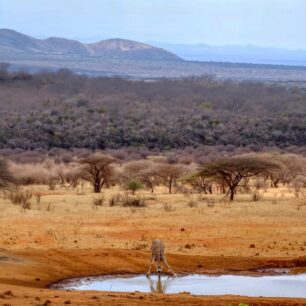
With its long legs, the giraffe adopts a peculiar and almost comical posture to drink. Here, in the semi-arid expanse of Tsavo West, a giraffe lowers itself to sip from an essential waterhole. The scene is framed by a stunning backdrop of rolling hills, acacia trees, and scrubland, while the bone-dry foreground provides a stark contrast to the life-giving water. Survival in this rugged landscape is not an easy thing.
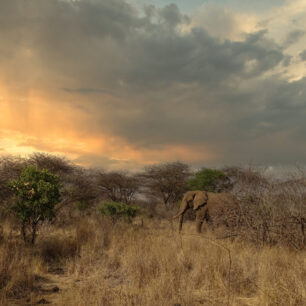
We were actually making our way out of Tsavo West, heading back to Nairobi. As we passed through dense thickets of bush and acacia trees, a solitary elephant emerged from the behind some trees, framed by the first light of the rising sun. It just feels very special —the crisp morning air, the tranquility, and the first light of day coming together to create an unforgettable experience.
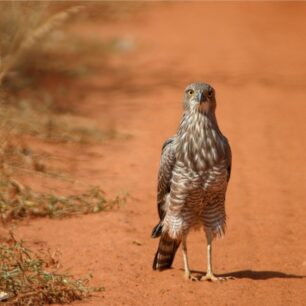
We were slowly driving down a dirt road in Tsavo West when, quite a distance ahead, we spotted what appeared to be a Pale Chanting Goshawk moving through the vegetation alongside the road. Using a long lens, I managed to capture a rather decent shot.

Tsavo West is a fascinating park that offers awe-inspiring vistas, dotted with rugged mountains, volcanic deserts and towering hills. Its pristine springs and waterholes attract a diverse array of wildlife, including elephants, buffalo, giraffes, leopards, and a variety of gazelles and other species. In this picture, you can see the morning sun casting a warm light over the semi-desert landscape, creating a truly special moment.

Perched atop Kamboyo hill, the Kamboyo Guest House boasts arguably one of the best vistas in Tsavo West. Formerly the head ranger’s residence, with the KWS headquarters nestled just behind, the guest house offers unparalleled views. From the terrace, guests are treated to a fantastic panorama: the Chyulu hills rise to the right, while to the left, the expansive plains stretch towards the horizon, punctuated by distant mountains. As dusk descends, the scene becomes even more enchanting, with elephants and buffalo gathering at the waterhole below, creating a truly wonderful experience.
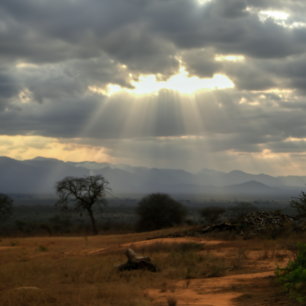
Sometimes you get lucky and capture a great picture without even trying. This happened to me during a stay at Kamboyo. I went for a walk after an early dinner, and the clouds parted dramatically, revealing the last rays of the setting sun. In the background you can see Chyulu Hills.
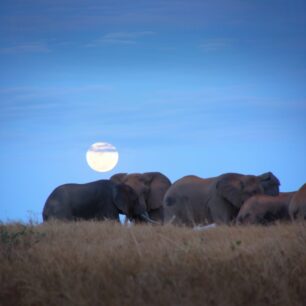
Returning from a long game drive, the sun dipped below the horizon, painting the sky in deepening hues of twilight. As our vehicle slowly ascended the hill towards Kamboyo house, our stay for the night, a breathtaking scene unfolded. A family of elephants, bathed in the blue light of the rising moon, loitered around the waterhole, their bodies casting long shadows in the dusk. The long exposure lends a slight blur to the image, but it perfectly captures the serene atmosphere of that moment.
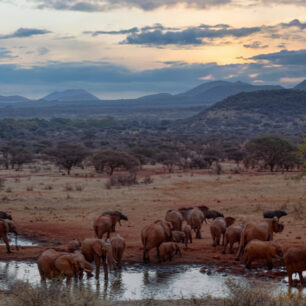
Under dark skies, elephants gather at the Kilaguni water hole, their silhouettes stark against the dry landscape. Tsavo West, known for its arid conditions, forces animals to embark on long journeys to reach these precious water sources. Dawn, dusk, and the cool night hours bring a broad selection of wildlife to these oases.
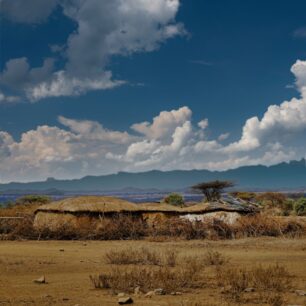
The Maasai people have a rich tradition of constructing their homesteads, known as enkangs, using readily available natural materials. These distinctive dwellings are built from a framework of branches and saplings, plastered with a mixture of mud and cow dung, which acts as a natural sealant and insulator. The enkang’s circular design, topped with a conical roof, reflects a deep connection to their environment. The roof’s open apex serves a practical purpose, allowing smoke from cooking fires to vent freely. Within the enkang, the earthen floor provides a cool surface underfoot, while minimal furnishings emphasize the communal nature of Maasai life.
Protecting the Maasai’s valuable livestock, a sturdy kraal encircles the enkang. Constructed from thorny acacia branches, this living fence effectively deters predators, safeguarding the cattle during the night.
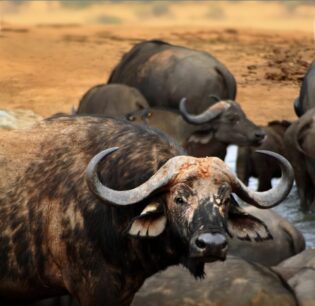
Under the relentless sun of a drought-stricken Tsavo West, a resilient buffalo emerges from the shimmering heat haze. Driven by thirst, it has likely journeyed for hours to reach this precious watering hole. In a final burst of energy, the buffalo charges the last hundred meters, hooves pounding the parched earth. A cloud of red dust billows in its wake, a dramatic testament to survival in this arid landscape.
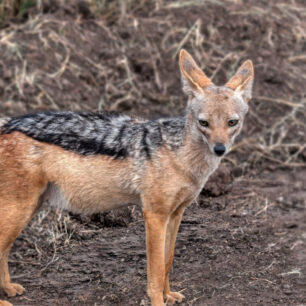
“This image captures a magnificent Black-backed jackal in its prime. With its distinctive black saddle and alert expression, it embodies the calculating and efficient trait of this species. Black-backed jackals are renowned for their speed and incredible stamina, allowing them to chase down prey over long distances.”
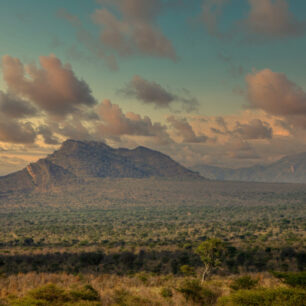
Tsavo West National Park in Kenya offers breathtaking views, capturing the essence of the African savanna. Small mountains rise across the landscape, creating a truly magical atmosphere. The image showcases a sweeping vista with dry savanna in the foreground, giving way to mid-sized hills and mountains shaped by ancient volcanic activity. Tsavo West is also renowned as the home of the maneless lions, made famous by the book “The Man-Eaters of Tsavo.”
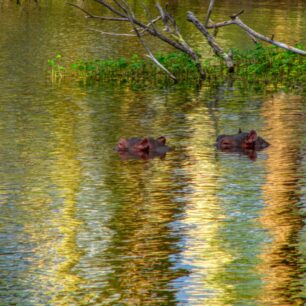
On a gorgeous afternoon in Tsavo West National Park, two hippos glide peacefully over the crystal-clear waters of Mzima Springs. A soft breeze dances across the surface, generating mesmerising ripple patterns that glisten in the golden light of the setting sun. The image is nothing short of stunning, demonstrating the sheer beauty of the African savanna.
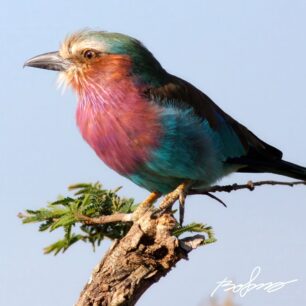
The Lilac-Breasted Roller, scientifically known as Coracias caudatus, is one of the most vibrant and colorful birds found across the Sub-Saharan Africa and the southern Arabian Peninsula. This avian species is most well-known for its breathtaking plumage, showcasing a dazzling array of colors. It has a lilac-colored breast, as its name suggests, along with a turquoise belly and wings that display hues of blue, green, and brown. The long tail feathers, often with black, blue and white tips, add an extra dash of elegance to its appearance. The Lilac-Breasted Roller feeds on a diet of insects, small birds, rodents, and occasionally reptiles. Despite its stunning appearance, it’s a fierce defender of its territory, and is known to be unafraid of diving towards larger predators when threatened. These birds also exhibit a unique flying pattern during their mating rituals, involving fast, shallow dives from considerable heights, which gave them their ‘roller’ moniker. The Lilac-Breasted Roller, with its striking beauty and distinct behaviours, is indeed a spectacle of the African wilderness.